
Consensual Sodomy
Notes from a parallel universe

We would like to welcome new paid subscriber Peggy Rutledge!
Murph Kinney, Lieutenant Colonel, US Army Reserves (Ret.), is a professor of history at SUNY’s Suffolk Community College and is working on a memoir. We are pleased to kick off Pride Month with this essay about her service and coming out under fire.
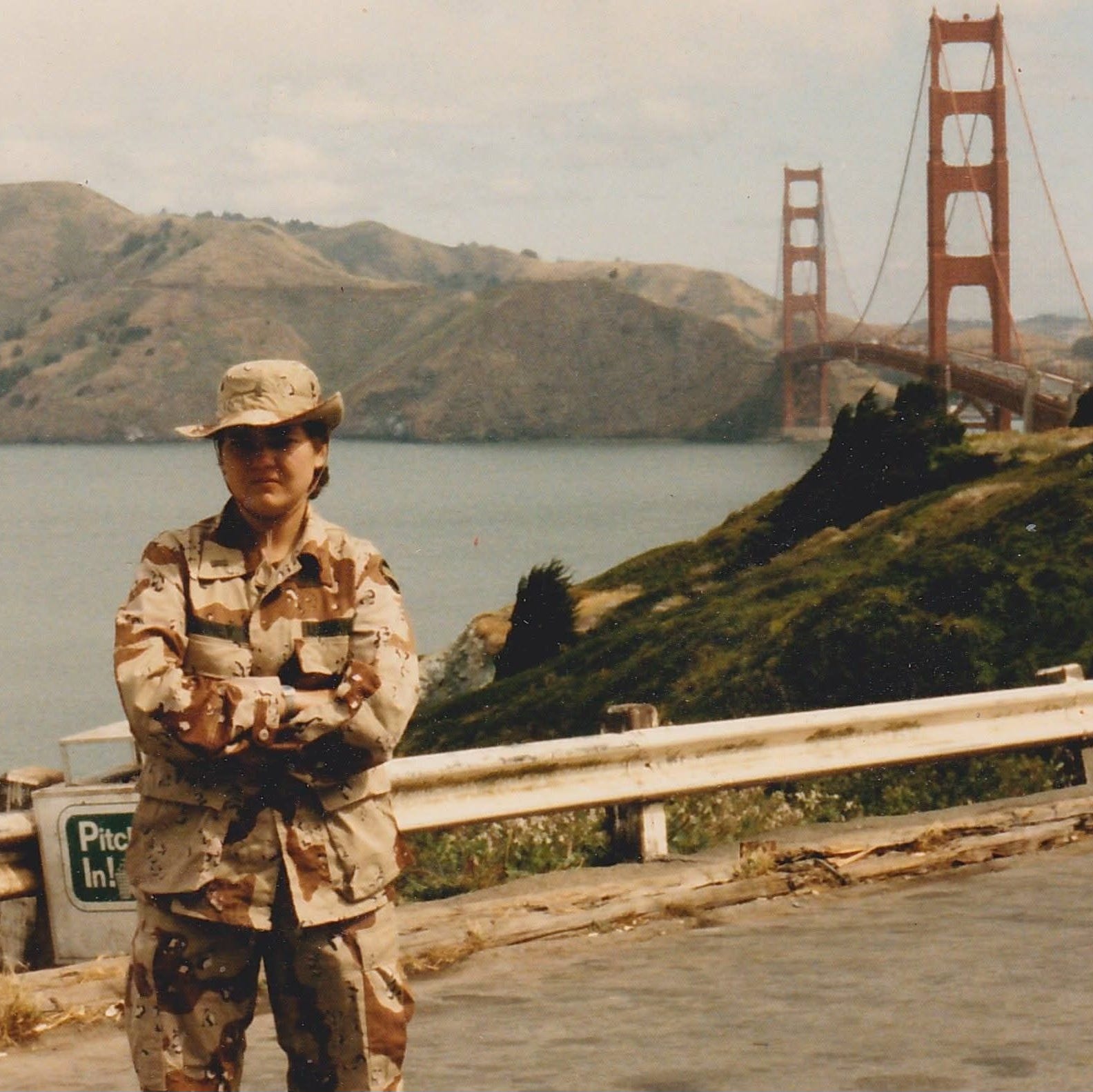
Second Lieutenant Kinney posing near the Golden Gate Bridge, San Francisco, CA, in the mid-1980s.
Consensual sodomy. Consensual sodomy. Consensual sodomy.
Three times that phrase appeared in a document I was compelled to read to my brigade on September 19, 2011 — the day before “Don’t Ask Don’t Tell,” the Clinton-era policy that prevented LGBTQ people from serving openly in the military—was formally repealed.
The document was the FAQ about UCMJ actions, which read in its entirety:
“Is consensual sodomy still a punishable offense under the Uniform Code of Military Justice?”
Answer: “Only in limited circumstances. Unrelated to Don’t Ask, Don’t Tell, the U.S. Supreme Court and the Court of Appeals for the Armed Forces found that private, consensual sexual activity, to include consensual sodomy, regardless of sexual orientation, is a protected liberty under the Fourteenth Amendment. Consensual sodomy can only be punished if it is prejudicial to good order and discipline, service discrediting (e.g., in public, between a superior and a subordinate) or there are other factors involved in the commission of the act such as force, coercion or involvement of a minor. This was true before repeal and it remains true now.”
Reading this document to the men and women who served in the brigade, I was choking back my laughter. Never in over 27 years had I imagined repeating that phrase –so sterile, legal, and just plain weird.
As Deputy Commander of the 595th Transportation Brigade, I sat at the head of the walnut table in our formal conference room at Camp Arifjan, Kuwait. Our headquarters staff was stuffed into the room, seated around the table and standing along the walls. A video feed broadcast the meeting to our downtrace, or subordinate, units in Bahrain and Oman: their commanders and staff looked back at me from 44-inch monitors. While it should have been Colonel John Sullivan, commander of the 595th, an angular, taciturn man, reading those words to us, he could not bring himself to utter the phrase “consensual sodomy.” So the honors fell to me.
Almost all eyes were downcast, not meeting mine; most soldiers at parade rest— usually the position of soldiers when a senior is speaking to them formally—though no one had asked it of them.
That day, in which private, uncoerced, homosexual relationships became legal in the United States military, marked the end of an era–one that for me began when I was commissioned an Army second lieutenant in May 1984. Though there was no single document I had to sign at commissioning, the regulations were unambiguous: homosexuality was incompatible with military service. For me, though, the regulations were irrelevant as I signed my papers.
***
I did not come out—even to myself—until a year after my commissioning.
One Sunday in June 1985, the streets around my parish were blocked after Mass, and I walked toward the noise. It was the 1985 San Francisco Gay Pride parade. I soon learned that there were lesbian bars near me—many of them. I entered a parallel universe, and as I explored it, learned a set of rules to keep it separate from my life as an Army officer.
I learned to park several blocks away from any bar where I socialized, to keep any Criminal Investigation Division (CID) agents from linking my car, with its base sticker, to those establishments. In time, I joined Presidio’s softball team and discovered that every woman on the team was gay. We became a close-knit group during the season, sharing apartments, heading to brunch in the Market District, and enduring dyke drama as teammates switched partners.
When I headed for a six-month deployment to Honduras, I became skilled at navigating and finding allies in this parallel universe. Peggy D., a more seasoned lieutenant, taught me to ask women about bars in the cities they came from, checking them against a mimeographed list of lesbian bars in every major city in the United States that she gave me — a code to determine if women were batting for our team.
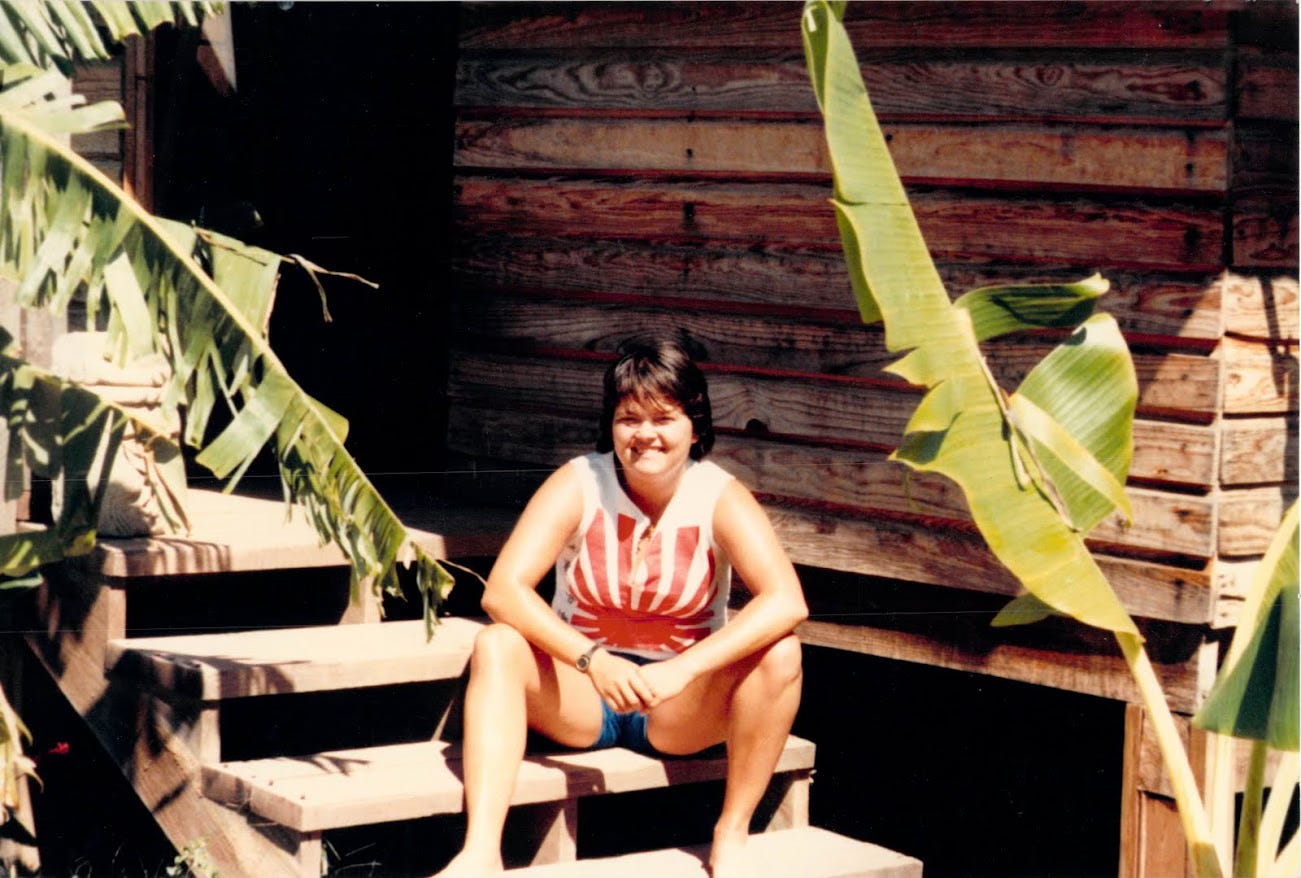
1st Lieutenant Kinney relaxes at on base in Honduras
Several of us were attracted to a helicopter crew chief, lean and tall in her flight suit. When she came to the post office to buy stamps—I ran the post office—I’d announce to Peggy and Dee, another officer in our hooch, that it was time for mail call, and they’d head to the mailroom to behold the chief. Peggy had a girlfriend — Dawn — stationed in West Berlin, and she never tired of speaking about “Donny” as we played spades. As Peggy drank more over the course of those evenings, I became increasingly concerned she would slip and say Dawn. She never did.
Transitioning to service in the Army Reserves after four years on active duty eased the need for continual subterfuge and I relaxed into a mainly civilian life, although my Reserve colleagues proved to be good dating material. A. joined my unit, both of us captains. We were together for ten years — and had no serious issues with the military.
Until the parallel universes collided.
***
In late 2002, I transferred from an overseas unit to A.’s unit. It was just for a couple months, until I could find another more suitable slot for a senior major. But before I could, our unit was mobilized to support the invasion of Iraq. The muscle memory from active duty kicked in — fifteen years later, I was still fluent at keeping my private life under the radar. Get a mail drop as a permanent address, register our cars in one name only, don’t make eye contact as we’re headed to formation.
We managed — until rank intervened. I was promoted to lieutenant colonel; A. still had another year before she was eligible. She was assigned to work directly for me, and we grated on each other — I divvied out busywork, she grumbled, and what was manageable at work became untenable at home. A. volunteered for Afghanistan, in part to escape working for me. It didn’t help
She went — but only after we registered as domestic partners in our home state of California, so that if she was killed or wounded, we would have legal status. The Army had no name for what we were — California did. But because those six months had no official name in any Army regulation, I had no contact with A. through her unit’s family support networks and no sanctioned way to even know if she was alive.
A. came home. But she came home changed.
Five years after that homecoming, mobilization orders came for me: A. served me with divorce papers as I was packing for Kuwait. At Ft. Dix, where I was stationed training troops, my work continued — units bound for Iraq and Afghanistan, soldiers to lead, altercations between officers to adjudicate — all while, my world was falling apart. It was Fall 2010, and DADT was still in full force. My relationship of eighteen years was ending, not with a bang, not with a whimper, but in a silence the policy required of me.
I packed my two duffel bags, programmed my divorce attorney’s number into my cell phone, and turned my dogs and house over to strangers. Then I boarded the flight to Kuwait. At last, I had something to focus on. I had been made the Deputy Brigade Commander of a transportation brigade–me, a personnel officer.
The learning curve was steep. I managed. More or less.
The divorce decree was issued on August 1, 2011. I deputized a young JAG officer to witness my signature on the decree affidavit. She assured me she was acting as a civilian witness and would keep my secret.
Six weeks later, when Colonel John Sullivan couldn’t bring himself to say the words, “consensual sodomy,” the onus was on me.
I choked back a laugh. I had endured. And I had witnessed. That would be enough.
Note that this Substack Live has been rescheduled from its original time:
On Tuesday, June 2, at 11:30 AM EST you can join me and The American Prospect’s Paul Starr LIVE to talk about Stephen Miller’s “white replenishment” project:
Short takes:
At Mother Jones, Aalah Abdullahi and Geoff Hing reveal that one way ICE ensures deportation is by moving detained people around the country so that they can’t meet with lawyers or know which jurisdiction in which to file their case. “Quick and repeated transfers have become more common in President Donald Trump’s second term, a Marshall Project investigation has found,” Abdullahi and Hing report, and it is a practice that precedes the current crisis. “From the final year of the Biden administration to the first year of Trump’s latest term, the number of people transferred five or more times more than tripled. The number of people transferred out of state within 24 hours more than doubled, according to a Marshall Project analysis of ICE detention data obtained by the Deportation Data Project.” (June 1, 2026)
Trump appointees at the National Science Foundation are moving to shut down the Social, Behavioral, and Economic Sciences division, which “funds roughly 63 percent of academic research in the psychological and social sciences,” Hana Kiros writes at The Atlantic. “Staff at the NSF learned last month, too, that the SBE division’s research budget for the current fiscal year is two-thirds smaller than last year’s,” which “was already at historic lows. Even that money seems not to have been passed on to researchers,” Kiros reveals. “By late May in a normal year, the NSF would give out about 250 social-science awards. This year, it has distributed five, according to Grant Witness, an effort that tracks federal research spending.” (May 30, 2026)
Where is Representative Tom Kean (R, NJ-07)? For almost three months, he “has not made public appearances, stepped onto the House floor, or cast a vote,” Connor Greene reports at TIME. On April 27, he issued a statement that he was ill, and week before last, he told the New Jersey Globe that he planned to be back at his desk in a few weeks. “As well as being absent from Congress for more than 75 days, NOTUS reported last week that Kean’s neighbors in New Jersey had not seen him and said that his home had been dark for a number of weeks.” No one seems to know, or want to say, what illness Kean is afflicted with: could he have had an emergency Trumpiotomy, in which a politician’s lips are surgically removed from the president’s behind? (May 29, 2026)
 | A guest post by
|
Thank you, Murph, for a terrific account of courage and resilience in the face of bigotry. Good lord, the way language can be butchered! "Sterile, legal, and just plain weird" is the perfect description of the phrase. Congratulations on being a first-time memoirist. More power to you!
On another note, it's painful to read that the Biden administration practiced the rapid transfer of people from state to state so they were unable to exercise their right to a lawyer or know where to file their cases. It's a false comfort when we imagine that Democrats are immune to nefarious practices. That kind of action causes voters to cynically say there is no difference between the parties. That and the inability of so many pols to use the word genocide to describe what the government of Israel is doing. Let's get more AOCs and Mamdanis into meaningful positions!