
Hotter Than July
Here's a quick catch-up: what happened to me last week, how the summer reading challenge is going, and a few short news takes--plus a poll!


Image credit: Derek Hatfield/Shutterstock
Hey political junkies! Since yesterday’s newsletter was so long, and could not bear the wait of some short takes, I thought I would send them out today, along with some other content of interest.
Just to let you know, the family emergency last week was a bomb cyclone that formed in the western suburbs of Philadelphia during the extreme weather week before last. It dropped a tree the length and weight of an ICBM on my mother’s house, which exploded the room over the garage—but fortunately, bad as it was, the damage was localized to that one spot, crushing a dormer window and carving one enormous hole in the roof. “The branches turn into spears,” one roofer explained to me.
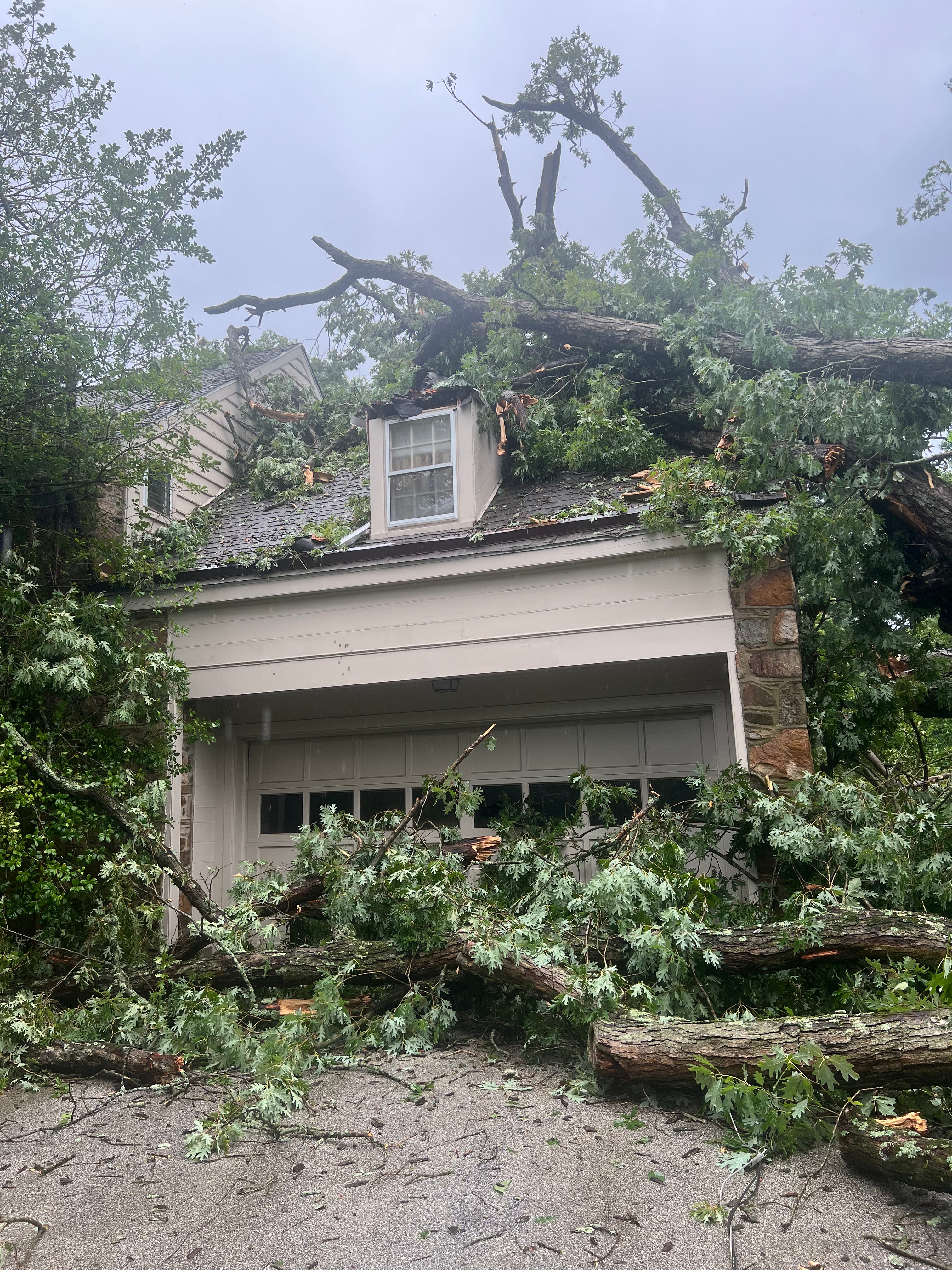
As anyone who has experienced catastrophic damage to their home knows, it is mind-numbing, exhausting, and requires fast action. Fortunately, the neighbors have been great; a lot of skilled workers have jumped into the breach to help fix the damage; my sister was able to come north for a couple of days; and we are on the road to normalcy.
But if you own a house, have someone look at your trees regularly. Seriously.
I also wanted to give all of you an update on how I am doing with my New York Times Summer Reading Challenge: I posted the full list of books here five weeks ago, in case you missed that post. Since then, I have:
Finished Gustave Flaubert’s Madame Bovary (1856), a truly ripping tale of a woman whose eroticism is stimulated by novels and consumer goods, and who is treated shabbily by her lovers, although she uses them too. Emma Bovary has the most boring husband on the planet, and he is also more than mildly stupid. In the end, Emma’s appetites consume her and everyone around her—it’s just really good that Amazon did show up for another century and a half, because she would have been done in almost immediately. Hard recommend.
Finished listening to the audiobook of Kiese Laymon’s Heavy: An American Memoir (Scribner, 2018), in which money is also a central theme: the lack of it, particularly the mismatch between the Laymon family’s status as intellectuals and their difficulty in meeting basic needs, as well as how money can buy pleasures—food, drink, gambling expeditions—that soothe the trauma inflicted by racism and and violence. You can guess from the title that Laymon, a successful writer and college professor, has suffered from disordered eating: it’s a painful account of something men rarely discuss, read beautifully by the author.
Read Timothy Snyder’s Bloodlands: Europe Between Hitler and Stalin (Basic Books, 2010), a political history of mass murder by two states, beginning with the manufactured starvation of almost 4 million Ukrainians by Stalin in 1932-33. Snyder makes the important argument that, if Hitler is more famous for genocide (a word that was not in use as a legal concept until 1944), Stalin invented the techniques of mass death that allowed large, corrupt political visions to be enacted in front of an unseeing, unknowing world. There are all kinds of parallels to our contemporary politics, one being that both Stalin and Hitler were completely mad and utterly incompetent. Each failure—of a Five-Year plan, of an imperial offensive—was followed by the decision to ethnically cleanse the terrain they controlled at the time. In addition, who knew that the use of “Zionist” as a slur seems to have first emerged on post-war Poland, when Jewish communist leaders trained in Moscow sought to avert the show trials occurring under Stalin by labeling their Jewish political enemies as “Zionists”?
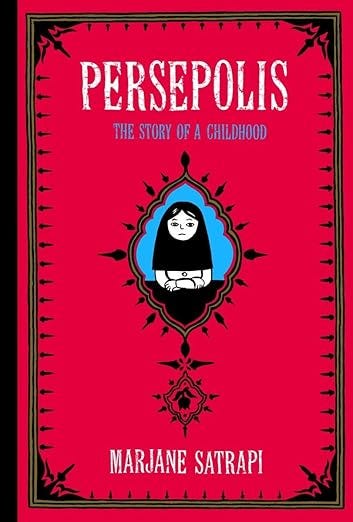
Just today, I turned the last page of Marjani Satrapi’s Persepolis (Pantheon, 2003), which is a memoir of how a child experienced the Iranian Revolution and the emergence of the Islamic state. People who know Iran will not be surprised to see a lot of freedom expressed behind closed doors—but also the loss and violence Satrapi has to try to explain to herself as she becomes a teenager. The period of the book also covers the Iran-Iraq War, in which Satrapi observes that the Iranian government seems to have avoided opportunities to end the conflict in the belief that defense of the homeland would allow them to consolidate otherwise fragile power. Maybe someone should leave a copy of Persepolis on Secretary of State Marco Rubio’s bedside table.
There hasn’t been a dud book yet! And with 2.5 weeks before I leave for my annual vacation on Martha’s Vineyard (where I will get to meet Georgia Senator Raphael Warnock at a small gathering—I know, I know a selfie or it didn’t happen, right?) I still haven’t chosen that library selection.
This poll will be up for three days: please help me shape the future of this Substack!
Short takes:
Federal marshals arrested MAGA manosphere celebs Andrew and Tristan Tate in Miami over the weekend: they were charged in Romania with sex trafficking and rape in 2022, but returned to the United States in 2025, reportedly after Trump Special Presidential Envoy Ric Grenell intervened with the Romanian government. “The Tate brothers have been deeply allied with MAGA for years, with Andrew Tate cultivating personal relationships with key figures in the Trump orbit—including Trump’s youngest son, Barron,” Jeet Heer writes at The Nation. “Andrew Tate had started cultivating a relationship with Donald Trump Jr. shortly after the 2016 election. After a visit to Trump Tower, Tate posted a photo of himself clasping the hand of the president’s eldest son, accompanied with a note reading ‘The tate family support trump FULLY. MAGA!’ On another occasion, Tate praised Donald Trump by saying, ‘He’s grabbing bitches by the pussy. I like that guy.’”(July 20, 2026)
Why has there been such a sharp rise in autism diagnoses? In fact, what we are seeing is elevated diagnoses of mild, rather than profound, autism, in which people are not intellectually, cognitively, or physically disabled, but struggle with social interactions and have intense interests. “This overdiagnosis trend, these experts say, can hurt both people incorrectly classified as mildly autistic and those with more severe forms of autism,” Olga Khazan writes at The Atlantic. Because there is no organic test for the condition, “clinicians must rely on a person’s own account—or their parent’s account—of their challenges. A recent study found that nearly half of the children who had been given an autism diagnosis in one clinic did not meet the criteria for autism when they were reevaluated in another clinic. Diagnoses can be especially off for kids with visual or hearing impairments or other disabilities.” (July 20, 2026)
In the department of things I did not know, it turns out that Syracuse, NY has been a cauldron of writers since the 1970s. This is in part because they are drawn by the MFA program built by Raymond Carver at Syracuse University, but also because it is cheap and quiet, something the fledgling author requires, and for much of the year, too cold to go out. “There are many community-centric organizations focused on developing writers, often led by graduates of the university, who’ve been increasingly staying in the area,” Anna Kodé writes at The New York Times. Kodé writes that Jay McInerny, who came to Syracuse at Carver’s urging to write Bright Lights, Big City, described the post-industrial urban environment as “like Eastern Russia, but with shopping malls.” (July 18, 2026)
As a pairing to Persepolis check out the graphic novel Wake Now in the Fire by Jarrett Dapier about a Chicago Public School’s attempt to pull Persepolis from the shelves and the students’ demonstration that ensued. Based on true events (and my kid’s high school, coincidentally).
I’m sorry about the house, how traumatic for everyone. Glad you are all safe, physically at least.
I hope your mom is doing ok, Claire; the tree falling on her home must have been quite a shock. I’m glad you enjoyed “Madame Bovary”. It’s one of my favorite 19th century novels.